The Long-Term Impact of Development Decisions in ERP Projects
Development often appears to be a fast and reasonable solution. However, the real cost usually emerges much later.
There is a long‑established principle in ERP projects: use standard functionality as much as possible. This is not a new idea. It has been repeatedly emphasized across methodologies and project experience. Yet when we look at real-world implementations, we often see that this principle does not receive the same level of practical commitment.
Although standard functionalities have become more comprehensive and mature over time, development decisions in ERP projects are still frequently made relatively early and quickly. This situation cannot be explained by a single reason; it is the result of several factors working together.
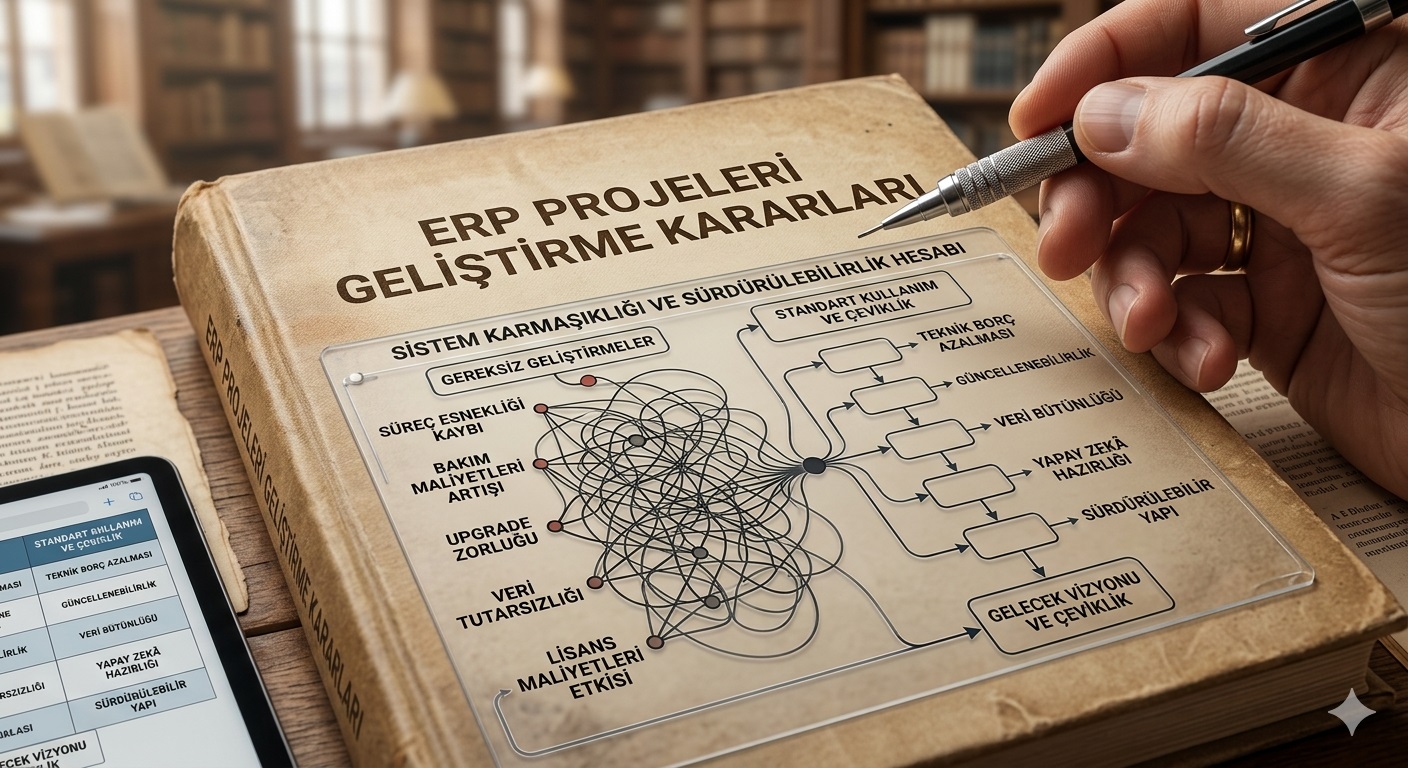
In many cases, development is no longer discussed as a clear alternative. Instead, it increasingly becomes the default outcome of the process.
As the system becomes harder to fully master, combined with the experience level of project teams, the tendency of business units to preserve existing habits, and the fact that development has become technically more accessible, development is evaluated earlier and earlier. This does not always cause an immediate problem—but it does create the conditions for one.
In this context, one question becomes especially important at the decision point: Has the possibility of meeting this requirement without development been sufficiently evaluated?
Why isn’t the standard used effectively enough?
There are several key reasons, and they often reinforce one another.
Familiarity with standard functionality
Platforms such as Dynamics 365 have matured significantly over the years. However, as the scope grows, it becomes increasingly difficult to evaluate all system capabilities accurately. As a result, in many projects, development decisions are made before the true limits of the standard solution are fully analyzed. Quite often, those limits become clear only after development has already been completed.
Attachment to existing business processes
By nature, ERP projects involve transformation. In practice, however, there is often a strong tendency to preserve existing processes as they are. This makes adapting the system to current processes more likely than adapting processes to the standard solution.
Perception of speed
Development can initially appear to be a faster solution. Evaluating standard functionality and rethinking processes takes time, while development provides a more direct path. However, this speed is usually limited to the first delivery; maintenance and adaptation effort increase afterwards.
Easier development processes
The fact that technical solutions can be produced more easily and quickly brings development to the table earlier. This does not automatically create a problem, but it does reduce the level of questioning during decision-making.
When all these factors come together, development often appears not as a conscious choice, but as a natural continuation of the process.
Where does the real problem begin?
Not at the moment development is done. The real impact emerges over time.
At first, addressing a requirement through development—when it could have been solved using standard functionality—gradually moves the system away from its standard structure. This shift is rarely noticed immediately, because the system continues to operate. Over time, however, the ability to evolve in alignment with standard functionality weakens.
In addition, such developments are usually designed with a narrow perspective, aiming to solve a specific need quickly. These solutions, often shaped by the knowledge and approach of just a few individuals, tend to struggle to keep up with the organization’s changing and expanding needs.
From this point on, the effects become more visible:
Loss of flexibility
As processes drift away from the standard structure, they become more resistant to change.
Dependency on individuals
The system can become dependent on the knowledge of the person who implemented the development. When that person leaves, the gap becomes more pronounced.
Software quality
Poorly documented developments directly impact support and maintenance processes.
Beyond the technical layer
Unnecessary development does not remain limited to the application layer; it also affects the core structure of the system. The data model may expand unnecessarily, data duplication and inconsistencies may arise, and poorly designed structures can challenge data integrity.
By nature, ERP systems tightly couple data models and business processes. As a result, a decision made at the development level can lead to consequences that affect the entire system over time.
Integration structures are also impacted. In systems that drift away from standard design, integrations become more fragile and more sensitive to change.
There is also an impact area that is often noticed much later: Licensing and role design.
Solutions that diverge from standard structures can indirectly affect role and authorization design within the system. Over time, this may lead to higher licensing requirements and additional costs.
How should we approach this?
There is no need for complex models. What matters is making decisions with a certain level of discipline.
In most projects, a similar sequence proves effective: first, standard functionality should be thoroughly evaluated;
if the need cannot be met, configuration options should be considered;
development should generally be the last alternative.
A critical point here is that “challenging the standard” is not purely a technical exercise. It requires a team with the right knowledge and experience. Understanding what standard functionality can truly address is closely linked to the quality of consulting.
At the same time, standard usage is not determined solely by consultants. The approach of business units is also a key factor. Moving to a new system often requires changing habits, rethinking processes, and stepping outside comfort zones. This can create resistance to standard solutions. Therefore, standard usage must be supported not only technically, but also organizationally.
Key questions at the decision point
Systematically addressing a few basic questions before deciding on development can significantly change the outcome:
- Is this requirement truly critical from a business perspective?
- To what extent can it be met with the standard solution?
- Will this development still be meaningful in 1–2 years?
- Who will own maintenance and support?
- How frequently is this requirement used? If it is rare, could a manual solution be more reasonable?
The last question is often overlooked. Some requirements may not be fully covered by standard functionality—but that does not automatically mean development is necessary.
The core question is this: How sustainable is the benefit gained in exchange for increased system complexity?
Development for a daily operation may make sense. Applying the same approach to a requirement that occurs only a few times a year often does not.
Therefore, development decisions should not be based solely on feasibility, but evaluated together with usage frequency, business value, and overall system impact.
A final observation
Success in ERP projects is rarely measured by the number of developments delivered. It is more closely related to how sustainably a system can operate with minimal development.
One critical point is often overlooked: an ERP project does not end when the system goes live. On the contrary, that is when the system’s life truly begins.
ERP systems should be approached not as one‑time installations, but as living structures that require continuous care, protection, and thoughtful evolution. Every intervention—even when solving a short‑term need—has long‑term consequences for overall system health.
It is not hard to observe this in practice. While projects often progress with clear discipline and control until go‑live, this structure can weaken afterward. Especially when internal teams try to produce quick solutions, interventions may enter the system without the same level of scrutiny.
While this can create a sense of agility in the short term, it often leads to systems that are increasingly complex and difficult to manage in the long run.
For this reason, the same level of care applied before go‑live must continue afterward. Monitoring system health, evaluating the impact of every change, and ensuring the solution remains technologically current are all essential.
Today, platforms such as Dynamics 365 evolve continuously and offer new capabilities through standard functionality. This allows systems to grow while benefiting from ongoing innovation. But this advantage can only be sustained if development decisions are made in a way that does not undermine this structure.
In an era where business applications are becoming more flexible and faster, especially with the help of artificial intelligence, development decisions require even greater caution.
To build sustainable, AI‑ready business applications, it is not only the need for development that matters but how that need is addressed.
Selamlar.
Fatih Demirci