AI-Ready ERP Architecture: Are Enterprise ERP Systems Truly Ready for Artificial Intelligence?
In today’s technology landscape, the “AI Revolution” has become the main topic of almost every meeting. ERP vendors are almost in a race to announce Copilots, AI assistants, and autonomous agents.
The promises are impressive:
An ERP that automatically creates purchase orders, predicts project risks in advance, and answers complex financial questions in natural language.
However, as an ERP architect, I cannot help but ask a deeper question:
Are our current ERP systems truly designed to work with artificial intelligence?
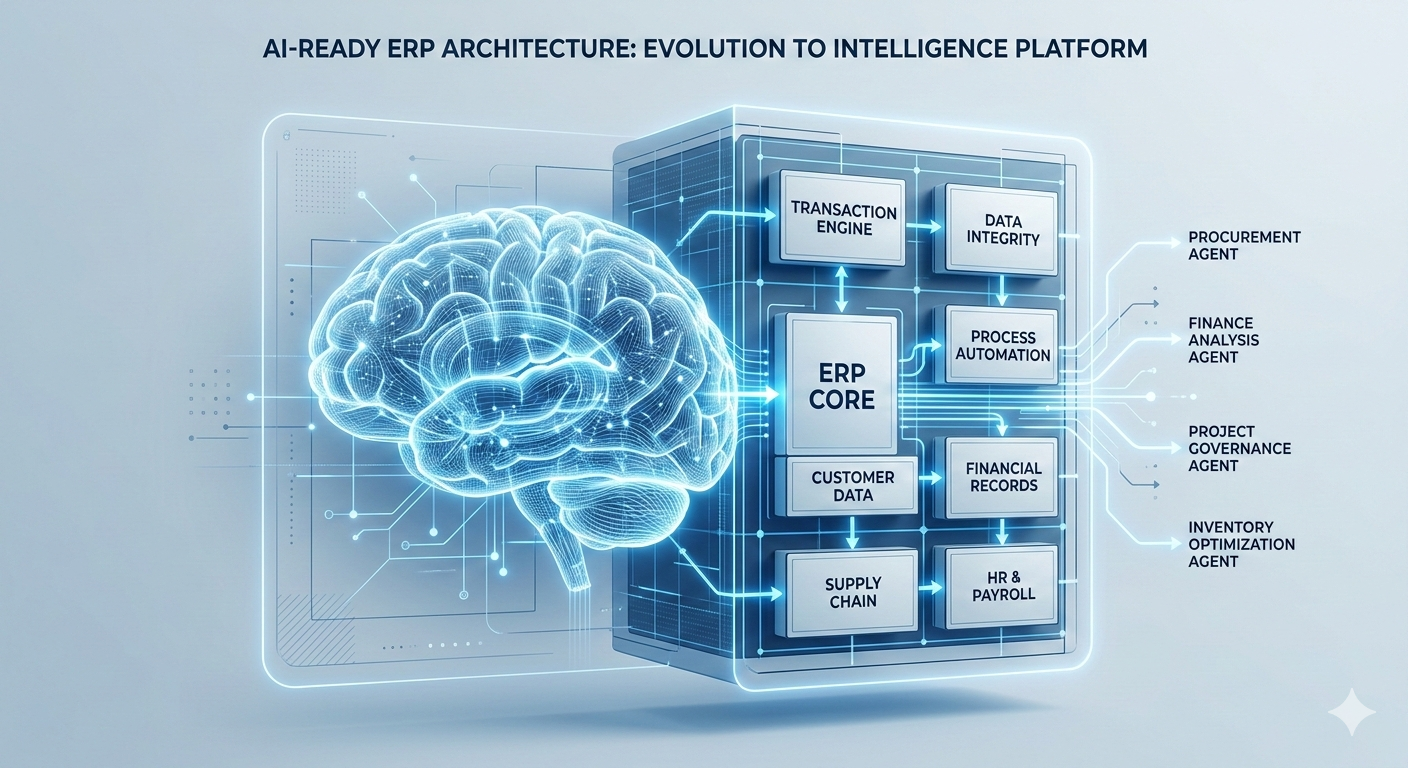
Traditional ERPs have been built for years as transaction processing fortresses. Their primary goals were data integrity, process standardization, and rule-based automation.
Yet artificial intelligence requires much more:
• context
• semantic integrity
• consistent knowledge layers
• fluid integrations
In other words, AI needs not only data but also meaningful, contextualized information.
If an ERP system does not have an architecture capable of providing this knowledge, AI often remains only a superficial assistant.
At this point, the critical question becomes: What architectural characteristics truly make an ERP system “AI-Ready”?
What Is an AI-Ready ERP Architecture?
An “AI-Ready” ERP architecture means that ERP evolves from being merely a system of record into a platform for knowledge and decision-making.
Traditional ERP systems were primarily designed for transaction management: recording data, executing processes, and enforcing rules.
AI-Ready ERP takes this approach one step further. The system does not merely record transactions; it transforms data into information that is understandable, contextual, and analyzable, providing a foundation that artificial intelligence systems can effectively use.
For this reason, an AI-Ready ERP architecture is defined not only by application features but also by the data, integration, and knowledge layers that support it.
In other words, ERP is no longer just a system that manages operations; it becomes a platform that provides high-quality data and context for AI models and intelligent agents.
In the following sections, we will examine the fundamental layers of this architecture and how ready enterprise ERP systems are for this transformation.
The Core Layers of an AI-Ready Architecture
1. Clean Data Layer (Semantic Integrity)
Artificial intelligence systems require more than correct data; they require meaningful, consistent, and contextually integrated data.
AI models generate insights by analyzing relationships between data. When data structures are inconsistent, these relationships break down and the reliability of model outputs quickly decreases.
Today, many ERP systems exhibit typical issues such as:
• inconsistent data structures
• excessively customized fields
• fragmented master data
• weak data ownership and governance
This type of data noise not only complicates reporting but can also cause AI models to establish incorrect context and produce misleading conclusions.
An AI-Ready ERP architecture therefore requires the data layer to be standardized not only technically but also semantically.
This approach demands strong master data management, clear data ownership, and consistent definitions of business concepts across the organization.
In other words, in an AI-Ready architecture, data is no longer merely a stored asset—it becomes the primary fuel of organizational intelligence.
2. Integration and Knowledge Layer
Artificial intelligence does not exist only within ERP.
To generate real value, it must also access organizational knowledge beyond ERP data.
For example, for a Finance Copilot to generate accurate insights, it needs to know not only financial records but also the surrounding context:
• what assumptions were discussed during the budget meeting
• which clauses were agreed upon in the contract PDF
• which risks were identified during the project kickoff meeting
Traditional ERP systems mostly record the answer to the question “What happened?”
Artificial intelligence, however, needs the context behind “Why did it happen?” in order to generate meaningful insights.
For this reason, in an AI-Ready architecture, ERP data alone is not sufficient. Different knowledge sources within the organization are integrated with ERP and gathered within a Knowledge Layer.
This layer typically includes content such as:
• emails
• meeting notes
• design and analysis documents
• project decision records
When this unstructured content is contextualized and made accessible to AI systems, AI moves beyond being merely a data-analysis tool and becomes a digital advisor capable of understanding organizational context.
3. Governance and Security Layer
Enterprise AI cannot operate as an uncontrolled system; it must function within well-defined boundaries—like a protected garden.
ERP systems contain some of the most critical information in an organization, from financial data to employee records. Therefore, AI access to this data must be managed within a strong governance and security framework.
In an AI-Ready architecture, this layer typically includes:
• data privacy and regulatory compliance
• role-based access and data authorization
• prompt security and data leakage prevention
• auditability and traceability of AI decisions
These mechanisms allow organizations not only to use AI but also to understand and audit how AI-generated insights are produced.
Without this layer, enterprise AI can quickly become more of a risk than an opportunity.
Dynamics 365: One of the Closest Reference Points for AI-Ready Architecture
When the market is examined, Microsoft Dynamics 365 stands out not merely because it offers AI features.
The real difference is that its core architecture has been designed from the beginning to align with the AI-Ready approach.
Dataverse and the Unified Semantic Data Model
Rather than storing data in isolated application silos, Dynamics 365 manages data through a unified data model built on Dataverse.
This structure not only simplifies data integration but also creates a rich metadata and relationship layer that AI systems and LLMs can more easily understand.
Such a semantic model provides a crucial starting point for artificial intelligence systems.
MCP (Model Context Protocol): A Game-Changing Structure
Very few ERP systems today provide the infrastructure required to deliver semantic business context to external AI agents.
Dynamics 365 addresses this need through the Model Context Protocol (MCP) approach.
With this structure, AI agents can request not only raw data from ERP but also:
• the business logic behind the data
• the context of the process
• relevant business rules
• data relationships
This approach positions Dynamics 365 not only as an AI-enabled ERP but also as a platform that can naturally collaborate with AI agents.
Microsoft Fabric Integration
Another key component of AI-Ready architecture is the ability to combine operational data with a powerful analytical platform.
The native integration of Dynamics 365 data with Microsoft Fabric and Lakehouse architecture eliminates many of the complex ETL processes traditionally associated with data projects.
This enables organizations to implement advanced analytical scenarios much more quickly, such as:
• predictive models
• risk analysis
• correlation and trend analysis
Why This Matters
In the AI era, the value of ERP systems will be measured not only by their ability to process transactions but also by their ability to feed and support AI systems.
From this perspective, Dynamics 365 stands out as one of the closest reference points for AI-Ready ERP architecture thanks to its modern data platform and open architecture.
The Future: The Era of Enterprise AI Agents
The ERP core will continue to function as the reliable transaction engine of the enterprise.
However, the way users interact with ERP is rapidly changing.
Traditional user interfaces are gradually being replaced by enterprise AI agents.
These agents will not merely query data; they will act as specialized digital collaborators in specific business domains.
For example:
• Procurement Agent – analyzes anomalies in the supply chain and identifies pricing or supplier risks early, providing recommendations.
• Project Management Agent – reads project plans, resource usage, and progress data to detect scope risks early.
• Financial Analysis Agent – continuously monitors financial data, performs variance analysis, and sends early warnings to the CFO.
This approach transforms ERP from a system that simply records transactions into something much more powerful.
ERP will no longer be just software that people use; it will become a digital colleague that analyzes data, generates insights, and takes action within the organization.
Conclusion
Today many organizations are discussing how to add artificial intelligence to their ERP systems.
In practice, however, the opposite is often true: AI capabilities are advancing rapidly, while the enterprise architectures that must support them are evolving much more slowly.
Yet artificial intelligence is not merely a new feature.
It represents an architectural transformation that directly affects how data is generated, connected, and understood.
Without clean data layers, structured organizational knowledge, strong integrations, and secure governance, AI often produces impressive demonstrations but fails to deliver real enterprise value.
For this reason, the real challenge is not adding AI to ERP systems—it is designing ERP architecture that can work effectively with AI.
Today, one of the closest approaches to this transformation can be seen in the Dynamics 365 ecosystem, with its data platform, semantic model, and open integration architecture.
In the AI era, the role of ERP systems is evolving.