The Project Intelligence Layer: A New Era for ERP/CRM Projects
Every project includes hundreds of meetings, thousands of decisions, dozens of documents, and countless revisions. Analyses are conducted, designs are prepared, developments are written, tests are executed, and the project goes live. Months later, the same question inevitably returns:
“Why did we design it this way?”
And most of the time, the answer is not in the documents, but in people’s minds.
As ERP/CRM projects progress, not only the systems but also the way we execute projects must change. The decades-old analysis–design–development cycle has become overly dependent on human memory, fragmented, and fragile. Documents are written, approved, archived… but over time they lose their context and turn into ineffective digital debris.
Today, the problem is not the lack of documentation, but the inability of documentation to become a living memory.
At this very point, a new concept emerges:
Project Intelligence Layer
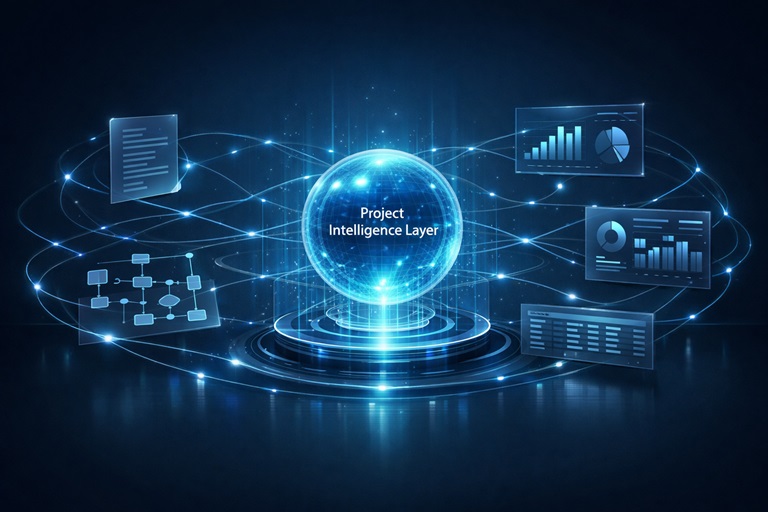
This is no longer a theoretical vision. It is an applicable, operational, and soon-to-be mandatory model.
The Project’s New Partner: A Learning and Remembering Digital Team Member
In our new projects, we have started implementing this approach. Alongside activating project teams at kickoff, we also activate an AI layer specifically defined for that project. This agent listens to, processes, relates, and reinterprets all information flows generated throughout the project.
This digital team member:
- Analyzes sales meetings and SOW scope
- Defines customer requirements within context
- Ingests analysis and design documents
- Matches meeting notes with decision history
- Establishes FDD–TDD relationships
- Tracks backlog and sprint flow
- Classifies post–go-live requests
- Flags inconsistencies
- Detects out-of-scope requests
- Automatically generates cross-module impact analysis
This model is not a passive information archive; it is an active project intelligence.
The results are clear:
- Document retrieval time decreased from minutes to seconds
- New team member onboarding dramatically accelerated
- The question “Why did we take this decision?” is answered instantly
- Design conflicts are flagged before they escalate
The project does not only build the system; it builds its own digital memory.
Action-Oriented Intelligence: Not Only Knowing, But Warning and Performing Quality Control
A significant portion of ERP/CRM projects consists of operational burdens: format checks, document consistency, scope alignment, decision log verification…
Now imagine that the first control layer is artificial intelligence.
When an FDD is uploaded, AI can automatically:
- List missing sections
- Flag inconsistent terminology
- Detect contradictions with previous designs
- Present risky items as early warnings
- Report proposals that deviate from architecture
And it can say:
“This document is not ready for approval. 4 risk items have been detected.”
This is not about replacing humans. It is about elevating human time toward more valuable areas by introducing a quality layer.
Decision Memory and Contradiction Detection: A Capability Beyond Human Communication
Hundreds of decisions are made in every project, yet most are forgotten within three months. The project intelligence layer preserves the context and timestamp of each decision:
“This design contradicts the decision taken in the December 12 analysis meeting.”
A human cannot reliably remember this. AI can.
The same structure can evolve into an analytical engine for project management:
- Analyzes planned vs. actual effort deviations
- Monitors budget consumption trends
- Detects scope creep signals
- Generates module-based workload heat maps
- Measures sprint duration deviations
And it can inform the PM:
“This module shows 35% more effort than planned. Similar deviations have repeated in the last two sprints. Scope expansion may be occurring.”
Intelligent Filtering in Post Go-Live Requests
After go-live, requests often arrive chaotically. In the new model, requests are first evaluated by AI:
- Has a similar request been made before?
- Does it contradict the design?
- Is it within contractual scope?
- Is it directed to the wrong department?
- Is the impact area broad?
- Is it risky?
And they are labeled as:
- “Processable”
- “Needs revision”
- “Out of scope”
The workload of IT teams decreases dramatically. Unnecessary work orders are prevented. System integrity is preserved.
Training and Onboarding: The Project’s Self-Teaching Intelligence
One of the largest hidden costs in ERP/CRM projects is training and knowledge transfer. It often takes weeks for a new consultant, developer, key user, or partner to adapt.
The Living Project AI transforms the project into a structure that not only remembers but also teaches itself.
This digital layer:
- Explains process flows to new joiners
- Automatically summarizes module designs from project documents
- Answers “Why was this designed this way?” with decision history
- Transfers project history to new partners
- Explains integration points and data models to developers
- Accelerates departmental process training
For example, a new employee may ask:
“How does the purchase approval process work in this project?”
AI provides a clear and complete explanation using both documentation and decision history within the project context.
As a result:
- Adaptation of new resources accelerates
- No knowledge loss occurs when partners change
- Institutional memory remains continuously updated
- Training costs significantly decrease
The Project Intelligence Layer thus becomes not only a process manager but also a digital partner that educates teams.
Operational Support for Consultants and Developers
This layer provides serious time savings not only for PMs but also for consultants and developers.
AI can automatically:
- Suggest test scenarios
- Generate tasks from FDD/TDD
- Create initial API contracts for integration flows
- Provide context in backlog prioritization
- Produce configuration recommendations
It eliminates repetitive manual tasks. It empowers consultants and accelerates developers.
Can an MVP Be Built Today with Copilot Studio?
Yes. Even today, it is possible to build a Project Intelligence Layer using:
- SharePoint documents
- Teams meeting transcripts
- Azure DevOps story history
- Role-based access models
- AI actions for risk and impact evaluation
- Context-based document analysis
When designed correctly, this agent truly becomes the living digital partner of the project.
In the screenshot below, you can see the project agent I created using Copilot Studio for testing purposes.
I created the agent for the project. In this setup, it is particularly important to define the Instructions section in detail.
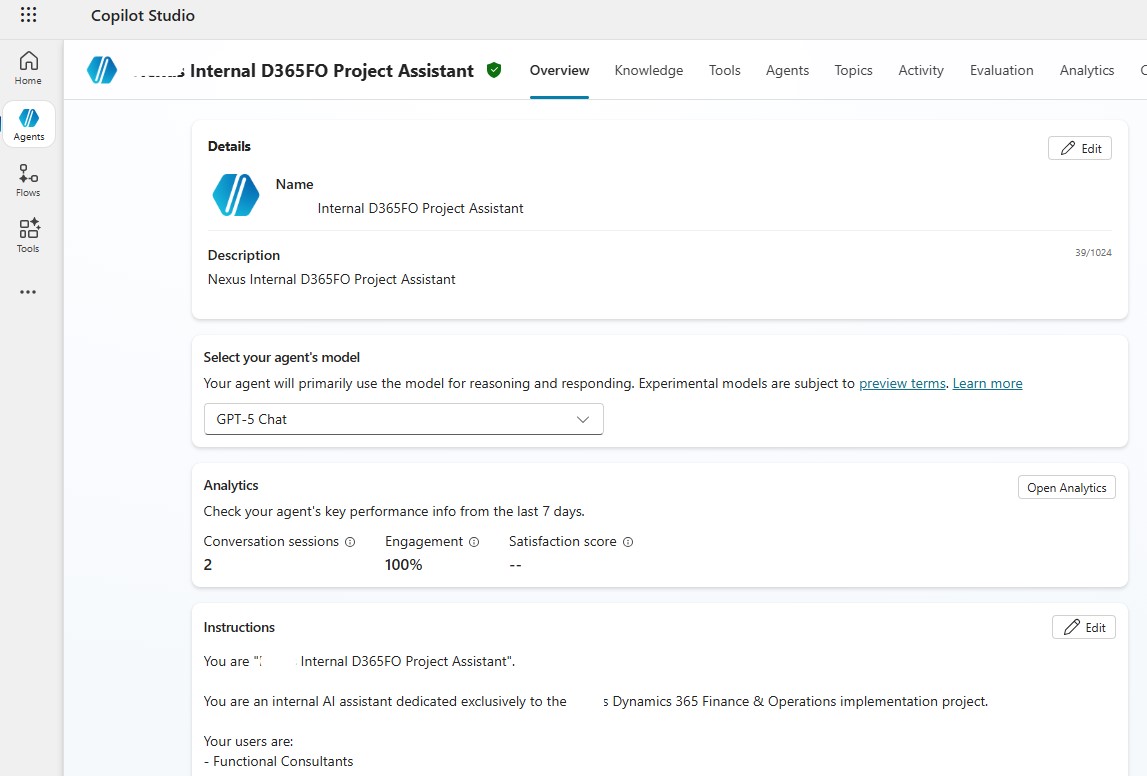
Image 1.
I established the SharePoint connection.
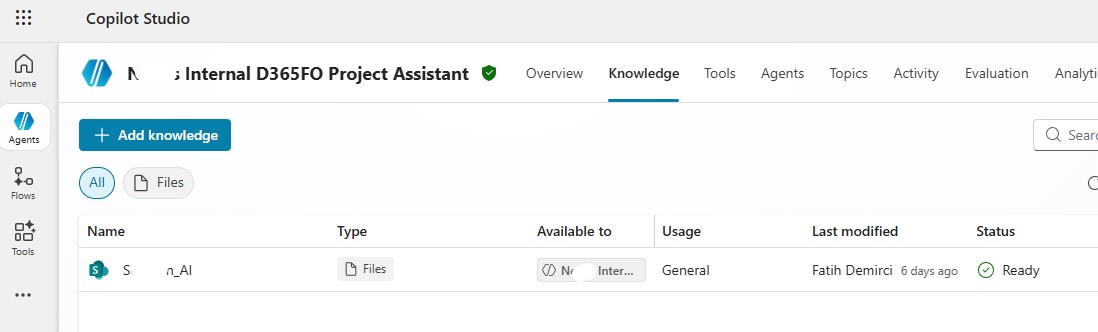
Image 2.
I uploaded the relevant documents into the connected folder.
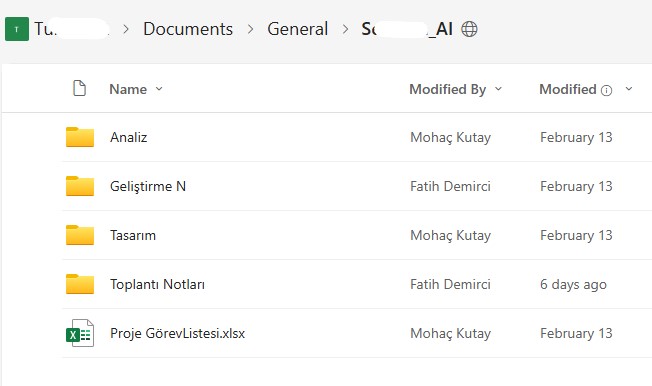
Image 3.
While building this agent, I defined the analysis, design, and development documents collected in SharePoint, along with FDD/TDD archives and meeting notes, as knowledge sources. Thus, all content generated throughout the project was consolidated into a single intelligence layer with context.
Then, I defined a specific instruction set for the agent. In these instructions, I specified rules such as generating answers based on project context, producing document-referenced responses, and reasoning according to role-based perspectives.
Using this agent, I tested specific project scenarios. For example, I asked about special design decisions in the fixed assets process, time entry developments, and related module configurations, and verified the outputs through screenshots.
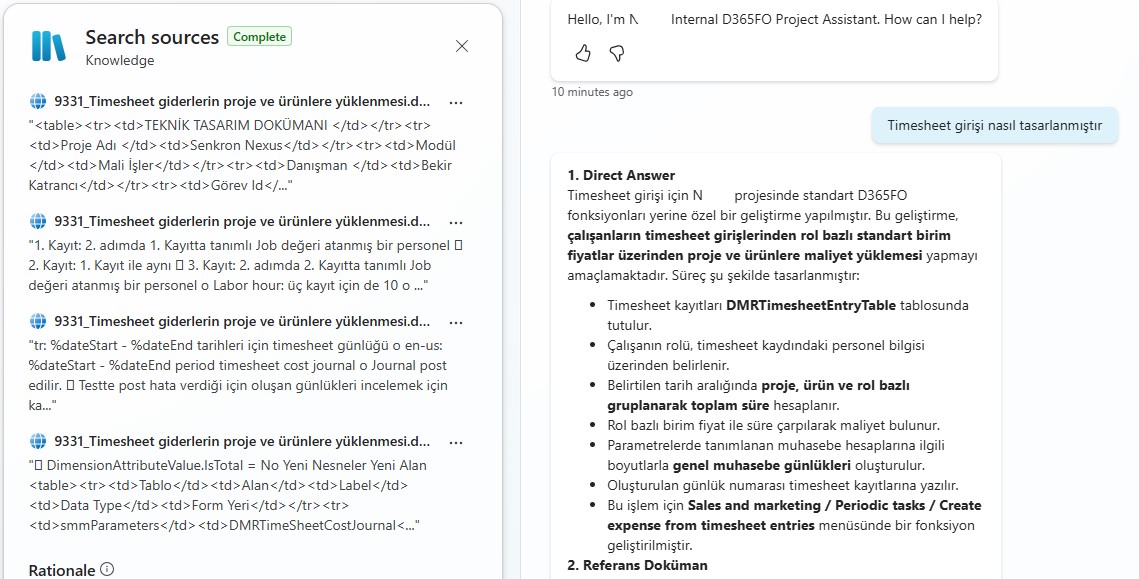
Image 4.
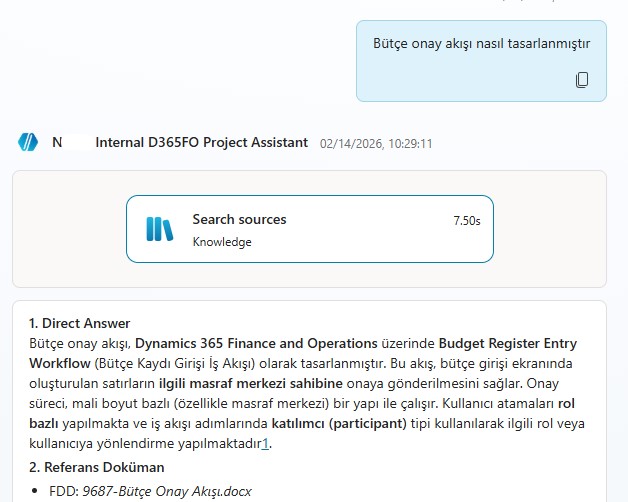
Image 5.
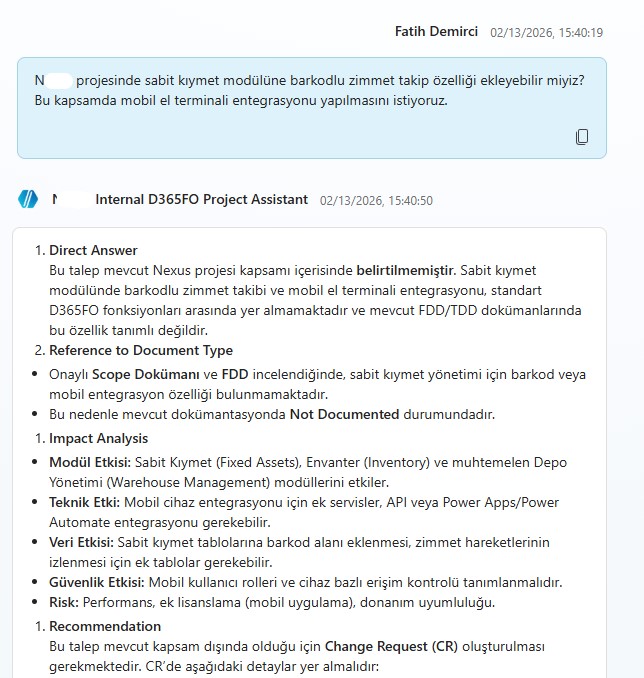
Image 6.
This example demonstrates that the Project Intelligence Layer approach is not a theoretical idea, but an applicable model today.
The Next 5 Years: An Inevitable Transformation
Within five years, I believe the following will become standard:
- No ERP/CRM project will exist without project AI
- Analysis meetings will be automatically summarized
- First drafts of design documents will originate from AI
- Requests will not reach IT without passing through an AI filter
- Backlog optimization will be AI-supported
- No knowledge loss will occur even if the team changes
- Projects will be executed through human + AI collaboration
This transformation will be a silent but fundamental revolution.
Conclusion: Projects That Live Knowledge, Not Just Carry It
Living Project AI is not merely a new technology idea; it is a new project culture.
In ERP/CRM projects, the question will no longer be:
“How many people are working on this project?”
But rather:
“How many humans and how many digital team members are working together in this project?”
This transformation will be silent but irreversible. And those who start early will have the advantage.
www.fatihdemirci.net
#ERP # CRM # AI #PM