Microsoft Ignite 2025: A New Era Begins
From Copilot-Driven Employees to Agent-Powered Business Processes – The Rise of the Digital Workforce**
While watching Microsoft Ignite 2025, one sentence kept echoing in my mind:
Every employee will have a Copilot.
Every business process will be supported by an Agent.

For me, this was the clearest and most transformative message of the entire event.
Copilot has already become a daily digital assistant for millions of workers—helping with emails, documents, and analytics. But with Ignite 2025, the story expanded dramatically:
Agents stepped onto the stage, introducing a new category of digital labor that understands business processes, takes action, and drives operations.
- Copilot → empowers the individual
- Agent → empowers the process
And together they form a new model:
The Digital Workforce.
In this article, I summarize this new post-Ignite era from my own perspective—spanning ERP, software development, partner opportunities, and organizational transformation.
1. Copilot + Agents: A New Digital Organizational Model
Until now, Copilot was positioned as an assistant that accelerates personal productivity. After Ignite, a new picture emerges:
- Copilot works alongside the user
- Agents work inside the business process
Agents can now:
- gather data
- apply business rules
- plan actions
- consult a human when necessary
- execute a workflow end-to-end and report back

Behind all of this stands Agent 365, a new platform that enables companies to define, authorize, monitor, and manage their Agents like real digital employees.
The message is clear:
Organizations are no longer made up of only people.
They now consist of Humans + Copilots + Agents.
2. Agentic ERP: The Evolution of ERP into an Operational Platform
Ignite introduced one of the most radical visions we’ve seen in years. ERP is no longer:
- a system that only stores data
- generates documents
- produces reports

With Agentic ERP, the system transforms into an operational platform.
This new model stands on three pillars:
1) Copilot Adaptive Experience
A dynamic interface that adapts to user role and business context.
2) ERP Agent Catalog
Microsoft-built agents + partner-built agents + custom agents designed in Copilot Studio.
ERP becomes an open platform for digital workers.
3) Headless Business Services + MCP
Operations are no longer tied to UI screens; MCP allows agents to call ERP actions directly.
One of the most striking statistics shared at Ignite:
➡️ 500,000+ ERP AI Actions executed
Meaning Agents can now:
- create purchase orders
- process invoices
- reserve inventory
- update workflows
- detect anomalies
- propose resolutions
Are humans removed entirely?
No.
But a significant portion of operational workload is shifting to Agents.
3. Humans, Copilots, Agents: How Business Processes Are Changing
After Ignite, I believe the new division of labor looks like this:
- Humans → strategy, oversight, decision-making
- Copilot → productivity and interaction layer
- Agents → execution and operational workload
This is especially visible in three key processes:
● Source-to-Pay
Agents analyze supplier risks, predict delays, manage PO changes.
In the “Supplier Communication Agent” example, order processing efficiency increased by 95%.
● Record-to-Report
Agents handle reconciliations, period closing tasks, and discrepancy detection—freeing finance teams for analysis and strategic decisions.
● Project-to-Profit
Time & expense management, workflow automation, anomaly detection…
Agents become the “engine behind the project team.”
ERP is no longer a system of record.
It becomes a system that runs the business.
4. MCP: The Language Connecting Agents with Enterprise Systems
One of the most exciting technical announcements was MCP (Model Context Protocol).
Think of MCP as the unified language enabling the flow between:
Agent → Data → Tools → ERP Actions
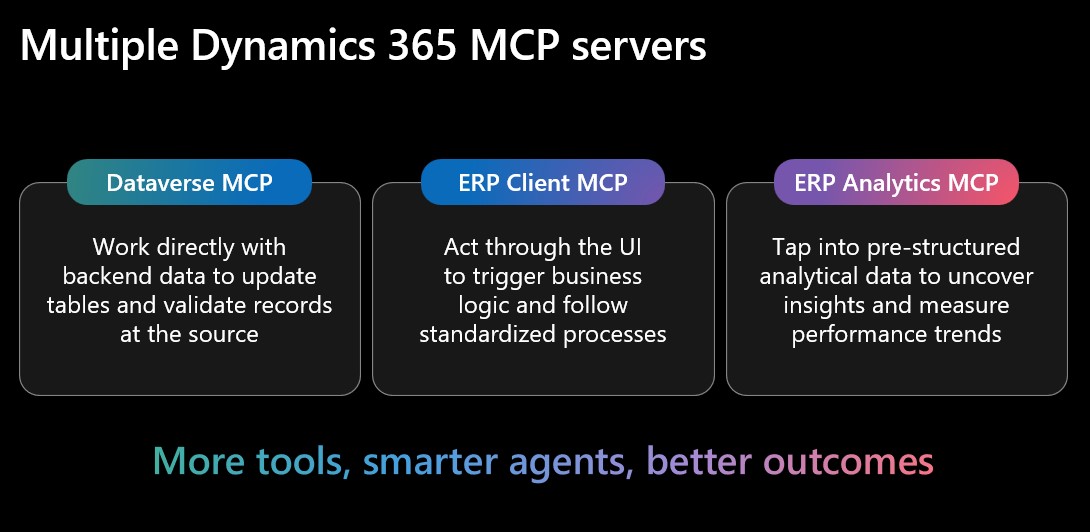
Until now, ERP actions were executed through screens and buttons.
With MCP, Agents can call actions such as:
- “update this PO”
- “create this invoice”
- “post this journal”
- “close this case”
directly and securely.
What does this unlock?
- Multiple Agents working concurrently
- Strict, role-based access to actions and data
- Better context → better decisions
- A shift from APIs to action-level orchestration
MCP is the missing piece that turns Agents into real digital operators.
5. The Agent Ecosystem: A New Opportunity for Partners
Ignite presented some early—but telling—numbers:
- 6 Microsoft 1st-party ERP Agents
- 25+ partner-built Agents
- Hundreds of custom Agents via Copilot Studio
Microsoft was very explicit:
The Agent ecosystem is the new app store of ERP.
This means a brand-new business model for partners:
Agent-as-a-Service
Instead of only building modules or traditional customizations, partners can now build:
- smart, autonomous Agents
- that execute full business processes
- and deliver measurable ROI
Forrester’s Ignite analysis highlighted:
- 10–15% higher win rates
- 10% additional consulting revenue
- 18% additional solution development revenue
- ~1:10 services-to-license ratio
This is not just an exciting technology wave—
it’s a huge economic opportunity.
6. The Developer’s New Role: From Writing Code to Designing Agents
The developer role is undergoing a major shift.
“The developer of the future will design Agents, not just code.”
This does not mean:
- “there will be no code.”
It means:
- the nature of coding changes.
Developers will focus on:
- task decomposition for Agents
- defining goals, constraints, and boundaries
- selecting the right tools
- managing context and prompts
- designing RAG-based knowledge flows
- orchestrating multi-Agent systems
Frameworks like Semantic Kernel, Autogen, and LangChain align perfectly with this model.
The developer becomes:
- an architect of interactions
- a designer of operational logic
- a builder of digital workers
This elevates development into a more strategic and business-oriented discipline.
7. 2026–2030: The Rise of Agent-Powered Organizations
Microsoft shared a bold prediction:
➡️ 1.3 billion active business Agents by 2028
This number is more than a trend; it marks a structural shift in how work will be performed.
My view of the future:
- Humans shift toward strategic, creative, supervisory roles
- Agents take over repetitive, rule-based, operational tasks
- ERP/CRM become the central hub for digital labor
- Copilot Studio becomes the platform for building the digital workforce
- MCP becomes the standard language for enterprise automation
The conclusion is inevitable:
Real transformation will only be possible with agents—
and with processes designed for agents.
This redefines how we:
- design new projects
- build enterprise systems
- deliver consulting value
- structure teams
Ignite 2025 was not simply a feature-release event.
For me, it marked the moment where Microsoft officially announced:
the future of business processes, workforce models, and enterprise software.
Those who translate this vision into practice in consulting, development, and product design
will lead the next decade of enterprise transformation.
Best regards,
Fatih Demirci
www.fatihdemirci.net
Tags: AI, Copilot, Dynamics365, ERP, CRM, MCP